The Collective Goal-Setting Cycle
Cultivating a Culture of Hope


Collective goal-setting may seem like trendy manager-speak but it’s as old as Greek mythology! The Hero Jason pulled together a sizable team of fellow heroes, heroines, and even a couple goddesses to help him retrieve the Golden Fleece and reclaim his rightful throne. From Hera blessing him and directing him to Pelias to Herakles realizing that Jason was being distracted by beautiful women and insisting that they keep moving, Jason relied on the collective efforts of his team to accomplish his goal–and he won their trust by assisting each of them in some way or providing a measure of comfort or safety they needed. While Jason set the overall vision, he relied on the team to help with identifying and fulfilling all sorts of intermediate goals along the way, and that’s our topic for today–the Collective Goal-Setting Cycle.
Today, we continue a mini-series sparking off the book, Hope Rising: How the Science of HOPE Can Change Your Life, by Casey Gwinn and Chan Hellman. This month, in the season of advent and light, we’re looking at the Primer principle of practicing Hope. Last week, we shared how Gwinn and Hellman (and many others, honestly) break hope down into the three components of the ability to set goals, the willpower or drive to accomplish those goals, and what they call “waypower,” or the ability to re-route and imagine multiple paths to achieving the same goal. Today we’re looking specifically at what we call a Collective Goal-Setting Cycle. Scroll down for a practical tool you can download and put to work right away with your team or even in your classroom.
With our interest in nodal leadership and nodal intelligence, we’re trying to think about how we as leaders create cultures of hope around us. How do we consider all the connections within our organizations and ensure that both individual members of our teams and our teams as a whole experience hope rising? We can’t take this task of creating a culture of hope lightly. Each year, the Gallup organization consults thousands of workers to assess the state of the American Workplace and the state of the Global Workplace. (Key Insights 2024 reports and in-depth report). The most significant finding, repeated year after year, is that “When organizations increase the number of engaged employees, they improve a host of organizational outcomes, including profit, retention rates and customer service.” (“2024 State of the Global Workplace” Key Insights, p.2) There are individual outcomes, as well. Disengaged employees have much higher reported rates of stress, anger, worry, sadness, and loneliness. In fact, wellbeing among younger employees is dropping quickly around the world and a full 1 in 5 workers report daily loneliness. Not only that, but HIGH engagement, in contrast, is strongly correlated with employees and managers experiencing hope for the future. Gwinn and Hellman say, “Leaders need to have hope to give hope to their employees. If you think about a supervisor or boss in your past that got the best out of you, the leader invariably challenged you to set goals and achieve them in a way that inspired you to set more goals and pursue even more pathways toward your goals irrespective of the obstacles.” (p.206)
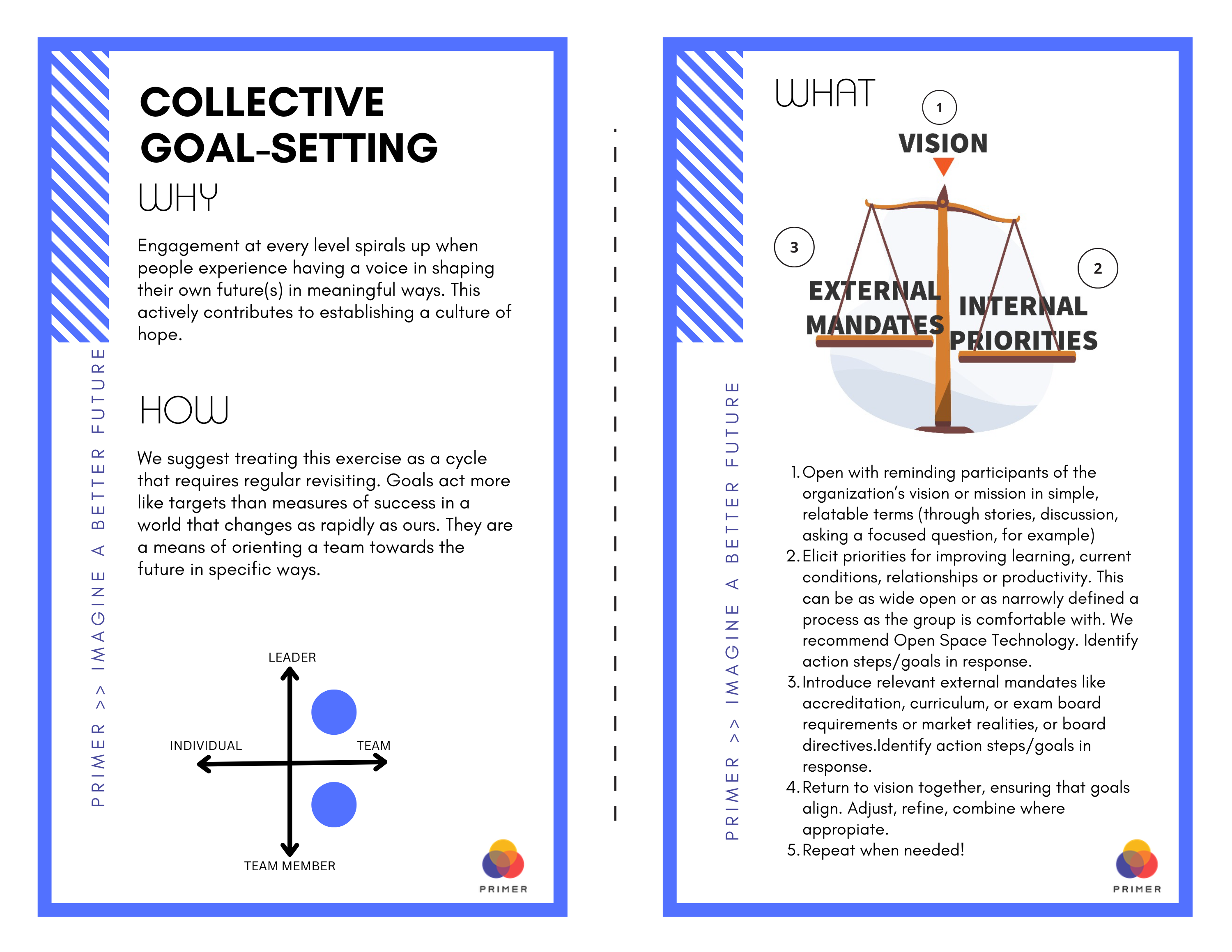
This brings us to goal-setting and why it matters so much. So, so many books have been written on goals–there are books on smart goals, on dumb goals, on big goals, on big hairy audacious goals….lots of books on goals! The majority of these focus (helpfully, I might add) on the nature of the goals themselves. Because the work in this area of defining goals is so exhaustive, we want to focus instead on the actual process of making goals. How do we, as aspiring nodal leaders, set goals effectively together? It comes down to a delicate balancing act and a cyclical process.
So, just like Jason and his Argonauts, every organization faces mandates and tasks that are pressed onto them from external sources. Jason’s team was challenged to plow fields with dragon’s teeth, for example. For corporations, these external mandates might be market factors or shareholder demands. In schools, they might be accreditation requirements or exam boards or, increasingly, the dictates of the host of software platforms we employ in schools. Even individual teachers face the external-to-their-classroom mandates of test scores and school- or district-wide policies. At whatever level we lead, it’s tempting to start the process of goal-setting with these mandates. And we would be utterly wrong to do this.
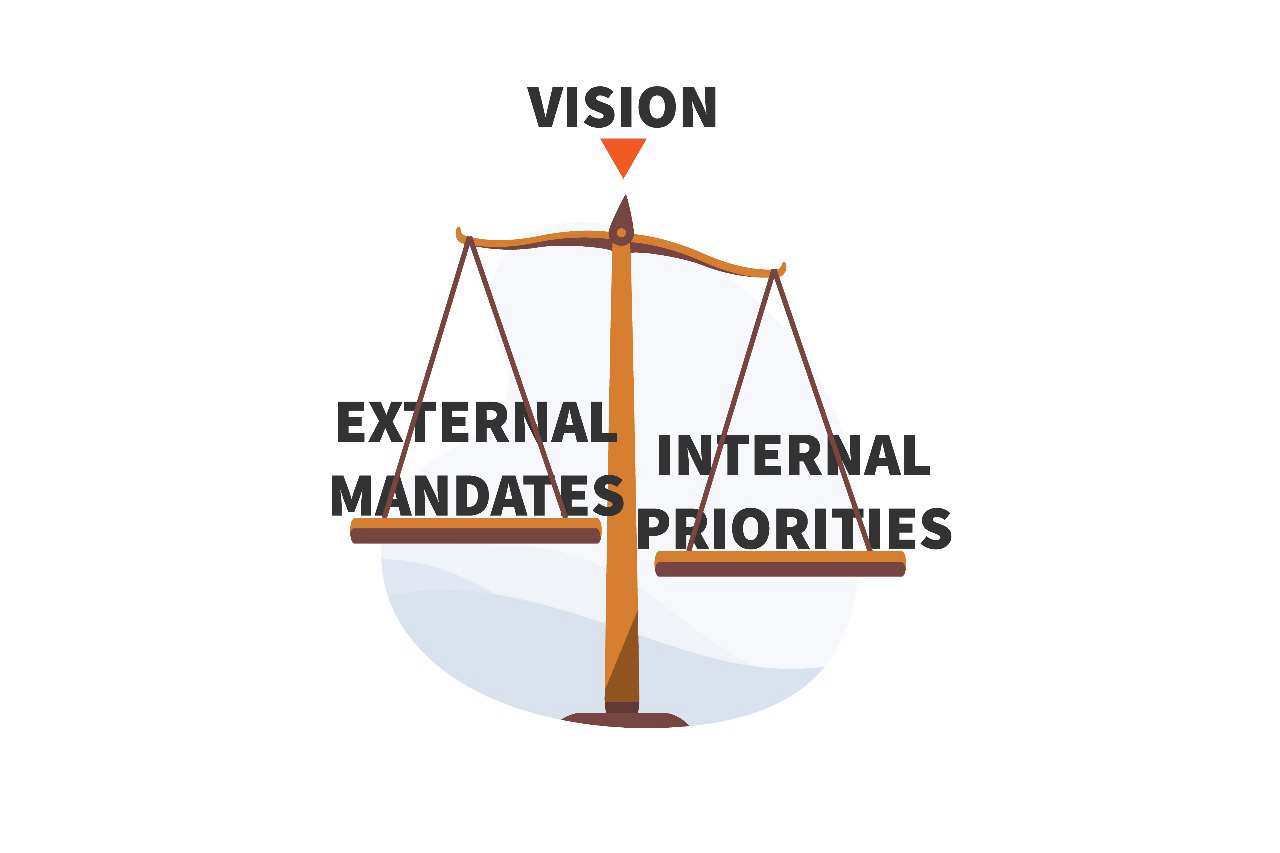
Instead, in every exercise of goal-setting, we must begin by reminding ourselves of our central vision or mission. I’m definitely NOT talking about always putting the mission statement on our first slide. I worked in a school where we had to memorize the mission statement and were given gift certificates when we could do so accurately. Nothing was more off-putting to us, as professionals. No, I’m talking about more organic ways of re-centering the organization’s mission and vision. Maybe you start the gathering with an anecdote that illustrates the mission in action. Maybe you paint a picture–metaphorically speaking–of a future in which the mission is accomplished, or ask team members to do this. Maybe you ask a mission-related question and give participants a few minutes to discuss with each other…there are infinite ways to creatively and meaningfully place the vision at the center of a goal-setting process.
From there, it’s critical to move into recognizing and naming priorities that team members have identified. At Woodstock School, we started using Open Space Technology during every Staff Retreat for this reason. It’s a simple facilitation method that allows participants to create and pursue their own agendas, growing a powerful sense of engagement and empowerment. It didn’t take much time and it always brought to light important priorities we hadn’t considered that, in turn, shaped our semester’s goals. For example, one semester it allowed us to see that we had a bullying problem in the middle school that required addressing. Another semester, it gave rise to a collaboration between student and faculty leaders in crafting an effective conflict resolution system. In a classroom, this might look like giving students time to share what pressures they’re experiencing and what they find challenging in the course.
Only when people’s voices have been heard and some action steps identified in response, does it make sense to turn everyone’s attention to external mandates about which we often have no say at all! In my experience, it’s very common to do the opposite–to begin with external mandates, perhaps visit vision, and MAYBE make it to some awareness of internal priorities. The engagement created by deeply listening and responding to internally identified priorities, on the other hand, spills over into discussion of turning external directives into specific goals. Not only that, but engaged team members are also more empowered, which leads into a generative space of helping to formulate reasonable, well-formed goals that meet external mandates. I’ve experienced this time and again, even in the classroom. When students see that I’m willing to set up extra study sessions or clarify rubrics or move due dates, they work with me to set academic goals that help them achieve high exam scores, for example. In essence, we’re creating a culture that strongly communicates that we are all walking in the same direction, and that everyone’s input and leadership is required.
This brings us back, of course, to mission and vision. A clear vision helps us balance internal priorities and external mandates without losing our way. It’s just as important to close a goal-setting exercise by returning to mission as it is to open with mission. Asking participants to check goals against the central mission in small groups or as a large group offers the opportunity to adjust or refine or even combine goals without being overwhelmed. The reason why we are calling this whole process a cycle is that–as we all know–internal priorities and external mandates are always in flow. While our mission or vision can be constant, our goals must be nimble and open to what Gwinn and Hellman call “re-goaling.” I used to think re-goaling was a sign of failure. Naming this constant balancing of external mandates and internal priorities–which, by the way, is as true for individuals as it is for organizations–has helped me embrace a more fluid approach to goal-setting.
Cultivating a culture of hope in our teams is a little like walking a tightrope together. The vision keeps beckoning us forward into the future we long to create. Setting effective goals depends upon a continual cycle of balancing the external mandates placed on us and the critical priorities that emerge from within. How might we build this cycle into the regular rhythm of meetings that we explored last month?
How do you approach goal setting? We’d love to hear! Feel free to leave a comment, email or send a voice memo to connect@primeredu.com. I’m Amy Seefeldt. Stay connected. It’s why we’re here.